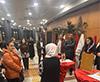
One of the important symbols of Kahramanmaraş’s deep-rooted weaving culture, the “Maraş Aba”, has been reinterpreted through contemporary art and transformed into a special project that carries cultural memory into the present. The exhibition titled “A Story of Brotherhood”, prepared by artist and academician Dr. Mutlu Aslantürk, met art lovers for the second time in Kahramanmaraş following its first presentation in Gaziantep. The collection, which was exhibited at the Panorama Museum within the scope of Gaziantep’s Liberation Day, this time met visitors at the Mehmet Akif Cultural Center as part of the 12 February Liberation Day events of Kahramanmaraş, finding a meaningful response in the city where the exhibition was born.
From traditional motifs to contemporary interpretation
The collection, consisting of 15 works, was created by reinterpreting Maraş Aba motifs through a modern artistic language. Each work transforms concepts such as solidarity, loyalty, resistance and cultural heritage into a visual expression, while demonstrating that traditional weaving culture can meet contemporary art. This approach, shaped by Dr. Mutlu Aslantürk’s academic background and field studies, shows that local values can not only be preserved but also reproduced. In this respect, the exhibition draws attention both in terms of the sustainability of cultural heritage and the expressive power of art.
A tribute to the spirit of the National Struggle through art
The exhibition “A Story of Brotherhood” goes beyond being merely an aesthetic work and presents a narrative that recalls the resistance carried out shoulder to shoulder by the people of Kahramanmaraş and Gaziantep during the National Struggle. While the joint struggle of Maraş and Antep militias is reinterpreted through the motifs in the exhibition, the works convey the spirit of solidarity and the sense of brotherhood of the period through the language of art. In this respect, the exhibition stands out as a cultural expression that keeps historical memory alive.
Motifs as elements of identity and memory
The Maraş Aba motifs used in the exhibition are addressed not only as aesthetic elements but also as carriers of identity, belonging and historical memory. In Aslantürk’s approach, motifs become a symbolic language of the connection with the past, social solidarity and cultural continuity. This situation also reveals that traditional weaving art is not only a craft but also a medium of expression.
A narrative extending from local to universal
Starting from a cultural value rooted in Kahramanmaraş, the exhibition aims to transform a local story into a universal artistic language. This approach, which brings together the traditional and the modern, redefines the relationship between textiles and art while demonstrating that cultural heritage can be carried into the future through different disciplines.